

Beginner's Gym Workout for Female Weight Loss: Spotlight on Dumbbells

This is a beginner's gym plan for women who want to lose weight, built around dumbbells because dumbbells are the easiest serious tool to learn on.
It covers what to lift, how much cardio to pair with it, how to eat around training, and how long the whole thing actually takes in a normal week.
It does not hand you a calorie number or a meal plan, because a stranger on the internet has no business setting either one for you.
Medical disclaimer: This article is general training information, not medical advice. If you have an injury, ongoing pain, or a medical condition, talk to a doctor or physical therapist before starting or changing a training program.
You will start light and add weight every few weeks, which is why a single fixed pair of dumbbells gets outgrown faster than most beginners expect. Our guide to the Best Adjustable Dumbbells 2026 walks through sets that span that whole early progression if you train at home.
What This Plan Is, and What It Is Not
It is a training plan with a short nutrition section attached, aimed at someone who has not trained with weights before.
It is not a diet. There are no calorie targets here, no food rules, and no list of things you are not allowed to eat.
Weight loss is driven by a lot of things, and a beginner who tries to fix all of them in week one usually fixes none of them by week six.
So the order below is deliberate. Get to the gym consistently first, add cardio around it second, and let the eating settle into something you can repeat.
Getting Ready: Physical and Mental Preparation
Before your first session, a check-up with your doctor is worth booking, especially if you have been sedentary for a while or have any condition that exercise might affect.
That visit is not a formality. It is the one step that tells you whether anything here needs modifying for you specifically.
On the mental side, pick goals you could hit in eight weeks, not eight days.
A goal like "three sessions a week for two months" is fully within your control, which is exactly what makes it a better target than a number on a scale.
Safety Basics for Your First Weeks in the Gym
Start lighter than you think you need to, then add weight once a set stops feeling hard.
The first few weeks are for learning the movement pattern, and a load you can control teaches that far better than a load you can barely move.

Form matters more than weight on the bar, and it matters most on the exercises you plan to repeat every week for a year.
If you are unsure whether a movement looks right, ask a trainer on the floor to watch one set.
Warm up for five to ten minutes before you lift, and keep water with you so fatigue does not arrive early.
If something hurts in a joint rather than burning in a muscle, stop that exercise and come back to it another day.
Why Dumbbells Suit a Beginner
Dumbbells let each side of your body work independently, which exposes and slowly corrects the strength differences most new lifters have between left and right.
They also fail safely. If a set goes badly you can put them down, which is not true of a loaded barbell across your back.

A single pair covers a lot of ground, because the same two dumbbells will squat, press, row, curl and carry.
And because gym racks run in small increments, you can move up a step at a time instead of jumping in the large jumps a barbell forces.
In my view a beginner does not need a complicated program. She needs a short list of movements she can repeat every week and load a little heavier over time.
The Weight Loss Workout Plan
Four Dumbbell Exercises to Start With
These four cover the major movement patterns between them, which is why they are a reasonable whole program on their own for the first couple of months.
Aim for two or three sets of eight to twelve reps on each, and add weight when the last set stops feeling like work.
- Goblet squat: trains the quads, glutes and trunk, and teaches you to sit into a squat with an upright chest.
- Single-arm dumbbell row: trains the lats, mid-back and biceps, one side at a time so neither side hides behind the other.
- Overhead press: trains the shoulders and triceps, and builds the overhead strength most desk-bound beginners are short on.
- Romanian deadlift: trains the hamstrings and glutes through the hip hinge, which is the pattern behind most safe lifting outside the gym.
If you want a wider menu once these feel routine, our library of 51 dumbbell exercises covers variations for every muscle group.
The Physical Activity Guidelines for Americans, 2nd edition, published by the U.S. Department of Health and Human Services, recommends muscle-strengthening activity covering all major muscle groups on two or more days a week.
Two full-body sessions clears that bar, and three gives you a little slack for the week something goes wrong.
Cardio That Fits Around Your Lifting
Cardio is worth doing for your heart and your endurance, and it does contribute to the energy side of weight loss.
What it is not is a punishment for eating, and treating it that way is one of the faster routes to quitting.
- Walking: the easiest to start and the easiest to keep, and it recovers fast enough that it never interferes with lifting.
- Cycling: low impact, easy to control the effort, and forgiving on knees and ankles.
- Swimming: full body, almost no joint loading, and useful if impact is a problem for you.
- Interval work: alternating harder efforts with easy recovery, which packs more work into less time but needs a base of steady cardio first.

The same Physical Activity Guidelines set the adult aerobic target at 150 minutes of moderate-intensity activity per week, which is two and a half hours.
That total does not have to happen in the gym, and for most beginners it will not.
The National Institute on Aging, part of the National Institutes of Health, makes the useful point that benefits show up even below that 150 minute mark.
So a week where you only manage 90 minutes is still a week that counted.
What Three Gym Days a Week Actually Cost You in Minutes
Guideline numbers are easy to say and hard to schedule, so here is the arithmetic written out.
This is a WorkoutHealthy planning estimate, not an industry standard, and every session length below is our assumption rather than a measured figure.
The formulas, in plain text:
- time in the gym per session = warm-up + dumbbell work + cardio
- weekly time in the gym = sessions per week x time in the gym per session
- weekly total time cost = sessions per week x (time in the gym per session + travel and changing overhead)
- walking minutes still needed = 150 - (sessions per week x cardio minutes per session)
The assumptions, stated out loud:
- Three sessions per week. This is our assumption, chosen because it clears the two-day strength guideline with one session to spare.
- Warm-up 8 minutes, dumbbell work 25 minutes, cardio 20 minutes. WorkoutHealthy planning assumptions, not measured data.
- Travel and changing overhead of 40 minutes per trip, from 15 minutes each way plus 10 minutes changing. Also our assumption.
- The 150 minute weekly aerobic figure comes from the Physical Activity Guidelines for Americans, 2nd edition, cited above.
Running the numbers:
- Time in the gym per session: 8 + 25 + 20 = 53 minutes.
- Weekly time in the gym: 3 x 53 = 159 minutes.
- Weekly total time cost including travel: 3 x (53 + 40) = 3 x 93 = 279 minutes, or about 4 hours 39 minutes.
- Aerobic minutes earned in the gym: 3 x 20 = 60 minutes.
- Walking minutes still needed: 150 - 60 = 90 minutes, which is 90 / 7, or roughly 13 minutes of brisk walking on each of the seven days.
Four hours and 39 minutes is the honest weekly price of this plan, and it is a good deal more than the 159 minutes people picture when they say "three hour-long workouts".
How the answer moves if the assumptions move:
- Train at home with a pair of dumbbells and the overhead falls to almost nothing, which drops the weekly cost to 159 minutes, about 2 hours 39 minutes.
- Make it a 25 minute drive each way and the overhead rises to 60 minutes per trip, which pushes the weekly cost to 3 x 113 = 339 minutes, about 5 hours 39 minutes.
- Drop to two sessions and the gym only supplies 40 aerobic minutes, so the walking gap widens to 110 minutes, or about 16 minutes a day.
The practical takeaway is that the walking is not optional garnish, it is a third of your aerobic total and it happens outside the gym.
Eating Around Training, Without a Diet Plan
Training changes what your body is doing with food, so it is worth understanding the three macronutrients in broad terms.
What follows is not a prescription, and no amount is specified because the right amount depends on your size, your medical history and your life.
- Protein: the raw material for repairing and building muscle after training. Lean meats, fish, eggs, dairy, beans and lentils all count, and variety across them covers the amino acid range.
- Carbohydrates: the fuel your body reaches for first during hard work. Whole grains, fruit, potatoes and vegetables all supply it, and eating some before a session generally makes the session feel better.
- Fats: necessary for hormone production and for absorbing several vitamins. Olive oil, nuts, seeds, avocado and oily fish are all reasonable sources.
The nutrition basics library from Mayo Clinic is a sound place to read further, and it points you toward a registered dietitian for anything individual.

A meal that works around training tends to be simple, something like fish with rice and vegetables, or eggs with toast and fruit.
There are no forbidden foods on this plan and nothing you eat needs to be earned back with cardio.
If you want individual targets, a registered dietitian can set them properly, which is more than any article can honestly do.
Rest and Recovery
Muscle is repaired between sessions rather than during them, which is why the rest days are part of the program and not a gap in it.
Doing more than you can recover from is the most common way a beginner stalls in month two.
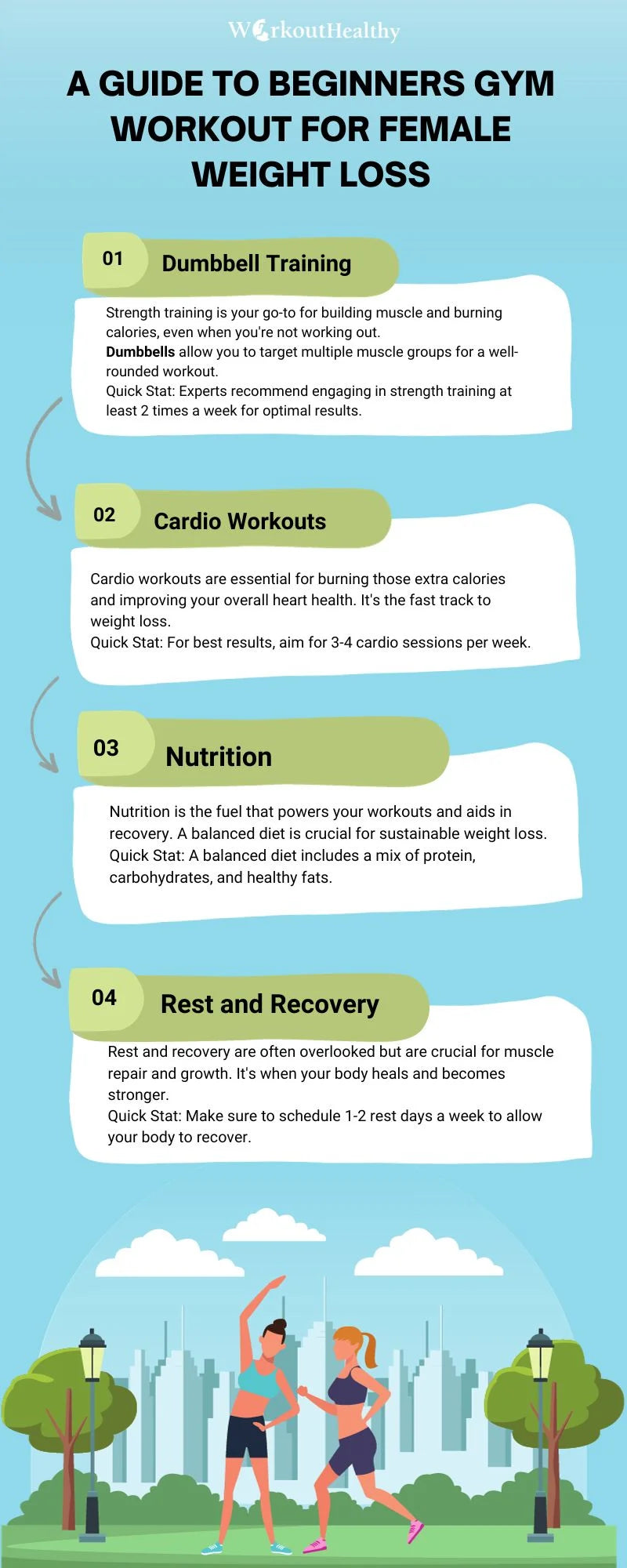
- Keep at least one or two full rest days each week.
- Use light activity on those days if you want to move, such as walking, easy swimming or yoga.
- Protect your sleep, since most of the repair work happens there.
The Physical Activity Guidelines recommend muscle-strengthening activity for all major muscle groups on at least two days a week, and they leave the spacing of those days to you.
Spacing them out is the sensible choice for a beginner, which is why a Monday, Wednesday and Friday layout works so well.
Staying With It
Setting Goals You Can Actually Hit
The goals that survive are the ones you control directly, such as sessions attended, rather than the ones you only influence, such as scale weight.
Make them specific and time-bound, and make the first one small enough that hitting it is close to certain.
According to the American Council on Exercise, working through a structured goal-setting process improves your odds of sticking with a fitness routine.
What the First Eight Weeks Actually Look Like
Weeks one and two are mostly about learning where things are and which weights are yours, and soreness is normal and settles down.
Weeks three to five are usually where the weights start moving up, because early strength gains come largely from your nervous system learning the pattern rather than from new muscle.
Weeks six to eight are where the habit either holds or does not, and that is the real thing being tested.

Through all of it the scale is a poor instrument, because it moves with water, food volume, hormones and the time of day.
Better early markers are the weight on your third set, how many sessions you got in this month, how far you can walk before it feels like effort, and how clothes fit.
The scale is the least useful number in a beginner's first two months, and it is the number most people stare at hardest. Watch what you lifted instead.
If you want a second view on how to structure those first weeks, our guide to a woman's beginner weight lifting routine lays out an alternative set and rep scheme.
Important Components for a Successful Weight Loss Journey
| Component | Why It's Important | Recommended Frequency |
|---|---|---|
| Dumbbell Strength Exercises | Builds and maintains muscle, and trains movement patterns | At least 2 times a week |
| Cardio Workouts | Improves heart health and aerobic capacity | 2 to 3 times a week |
| Nutrition | Fuels workouts and supports recovery | Daily |
| Rest and Recovery | Allows muscle repair and growth | 1 to 2 days a week |
Frequently Asked Questions
How Can a Woman Lose Weight at the Gym?
Through a combination of strength training, aerobic activity and eating patterns she can keep up, rather than through any one of the three alone.
Strength work protects the muscle you already have while the rest of it does its job.
What Gym Routine Should I Follow to Lose Weight?
A full-body dumbbell session two or three times a week, with cardio on the days between, covers both halves of the physical activity guidelines.
A simple version is Monday for full-body strength, Wednesday for cardio, and Friday for full-body strength again.
How Many Times a Week Should I Work Out to Lose Weight as a Beginner?
Three sessions a week is a sensible starting point, and it is the figure the time budget above is built on.
Consistency at three beats an ambitious five you abandon in a month.
What Should I Do on My First Day at the Gym?
Walk the floor, find the dumbbell rack and the cardio machines, and do one light set of each of the four exercises above to see where your starting weights are.
Writing those starting weights down is the single most useful thing you can do on day one.

Keep reading
Once the four movements above feel routine, the next step is widening the menu without changing the equipment.
Final Thoughts
The plan here is deliberately small, because a small plan you repeat for two months beats a thorough one you abandon in two weeks.
Four dumbbell movements, two or three sessions a week, walking on the days between, and food you can keep eating.
Everything else is a refinement you can add once that base is holding.
References
- "Current Guidelines," Physical Activity Guidelines for Americans, 2nd edition, U.S. Department of Health and Human Services, Office of Disease Prevention and Health Promotion. Available at: https://odphp.health.gov/our-work/nutrition-physical-activity/physical-activity-guidelines/current-guidelines
- "How can strength training build healthier bodies as we age?" National Institute on Aging, National Institutes of Health. Available at: https://www.nia.nih.gov/news/how-can-strength-training-build-healthier-bodies-we-age
- "Nutrition basics," Nutrition and healthy eating, Mayo Clinic. Available at: https://www.mayoclinic.org/healthy-lifestyle/nutrition-and-healthy-eating/basics/nutrition-basics/hlv-20049477
- "5 Steps to Success in Reaching Your Goals," American Council on Exercise. Available at: https://www.acefitness.org/resources/everyone/blog/5899/5-steps-to-success-in-reaching-your-goals/

![5 Best Dumbbells for Your Home Gym Space [2026]](http://workouthealthy.com/cdn/shop/articles/5_best_home_gym_dumbbells.webp?v=1767584598&width=1080)
Leave a comment